

Tims Smile Cookie Week in Lethbridge in Support of Green Shirt Day
MEDIA RELEASEFor Immediate Release Smile Cookie Week Launches in Lethbridge in Support of Green […]

Every year, hundreds of Canadians living with advanced kidney disease hope for the life-changing gift of a transplant. For many, a family member or friend is willing to donate — but sometimes they aren’t a compatible match.
That’s where the Kidney Paired Donation (KPD) Program, a flagship initiative of Canadian Blood Services operating in partnership with the transplant community, steps in.
Working with the living donation and kidney transplant programs across the country, the KPD program creates new possibilities by matching living donors and transplant candidates, making transplants possible even when a direct match is not.
Imagine this scenario:
You want to donate one of your kidneys to a loved one, but medical tests show that the two of you are not compatible (incompatible). Somewhere else in Canada, other potential donors and transplant candidates are in the exact same situation.
KPD looks for matches between these incompatible pairs; giving donors a way to help someone they know receive a kidney, while also donating a kidney to someone else in need. By swapping donors, more transplants become possible — giving several people the second chance at life they’ve been waiting for.
This is the heart of kidney paired donation: pairing, matching, and connecting Canadians through a shared commitment to saving lives.
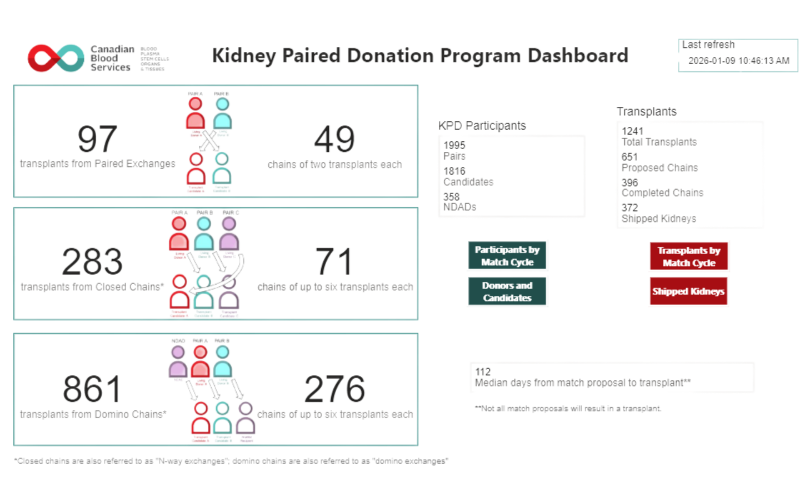
The KPD program is powered by the Canadian Transplant Registry, a secure national database managed by Canadian Blood Services.
Here’s how the process unfolds:
Once the potential donor candidate is approved by their local living donation program for donation, the potential donor and transplant candidate sign consent forms allowing their medical information to be entered into the Canadian Transplant Registry.
The Canadian Transplant Registry uses a specialized matching algorithm to assess compatibility between donors and recipients anywhere across Canada.
The matching algorithm finds matches that can fit into chains of matches, with donors from one pair matched to transplant candidates from another pair. Non-Directed Anonymous Donors (NDADs) can enroll in KPD to start off a domino chain, which is a chain of matches that ends with a person from a local deceased waitlist also receiving a kidney from a living donor.
The matching algorithm was created to ensure equity and better access to transplants for higher needs patients, and to maximize the number of potential transplants for a given set of patients.
When a possible match is found, the donor may undergo additional testing to ensure their kidney is suitable for the candidate they’ve been matched with.
Once all donors in a chain are approved as suitable matches for their potential transplant candidates, the transplant and living donor programs work together to schedule surgeries. Donors typically have their surgery at their local program to limit financial obligations and stress, and their kidney is shipped to the transplant program.
The ultimate goal?
To provide each transplant candidate with the best possible match and the best chance for a successful, long-lasting kidney transplant.
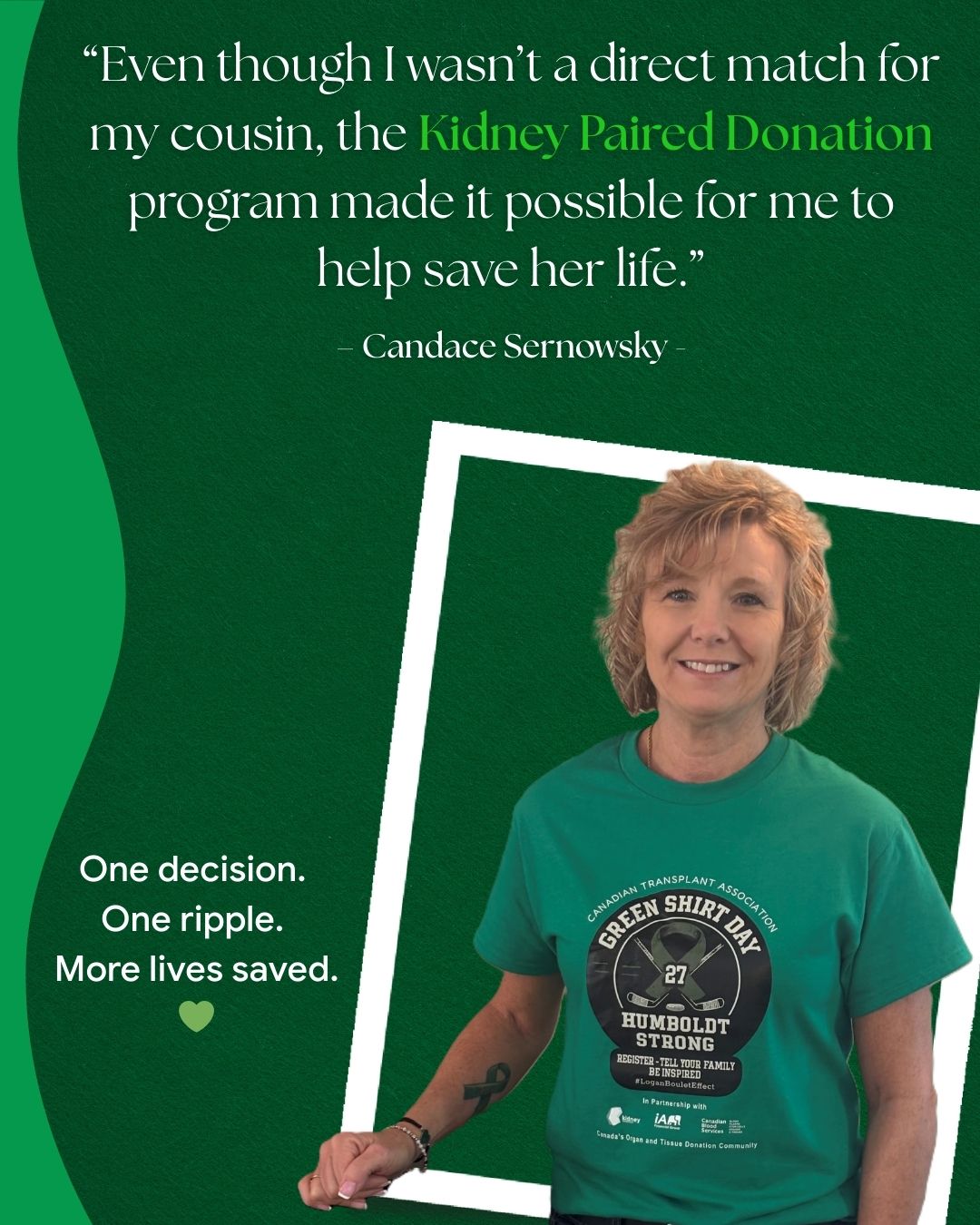
The KPD program:
It’s part of the powerful, interconnected system of generosity and hope that defines organ donation in Canada — the same spirit celebrated through Green Shirt Day and inspired by Logan Boulet’s legacy.
To explore the program, eligibility, and how it works across Canada, click here.